Kleine Krone goes big time – The online casino ready for the breakthrough


Kleine Krone goes big time – The online casino ready for the breakthrough
How we developed a social casino for the SCHMIDT.GROUP based on an infinitely scalable serverless architecture.
Around three years ago, a former colleague came to me and told me that he was planning to launch a large social casino platform on the market. The conversation eventually resulted in an assignment and for the first time I got seriously involved with the topic of "social gambling" in general and online casinos in particular. For my colleague Chris Figge, on the other hand, this was home territory: formerly employed at the Hamburg-based social casino provider Whow Games, he knew exactly what we were up against. He also knew what we could do differently. We tackled the project head-on and dared to take a new approach.
More than just a copy
The SCHMIDT.GROUP is already familiar with casinos thanks to its 180 gaming stations. Now the whole thing was to be transferred to the internet under the name Kleine Krone. And by "the whole" I don't just mean the slot machines, of which there are already thousands online. The focus was rather on optimizing the gaming experience and the long-term player loyalty.
What actually keeps players at a selected online casino is not the slot machines, which predominantly differ in color and theme. It is in fact the meta-games, which unite all the gaming machines under one umbrella, which are most crucial. The simplest example of this is a quest system, whereby users are tasked with completing a certain number of spins in a day, for example, in order to move up in level. But we wanted something more engaging than this.
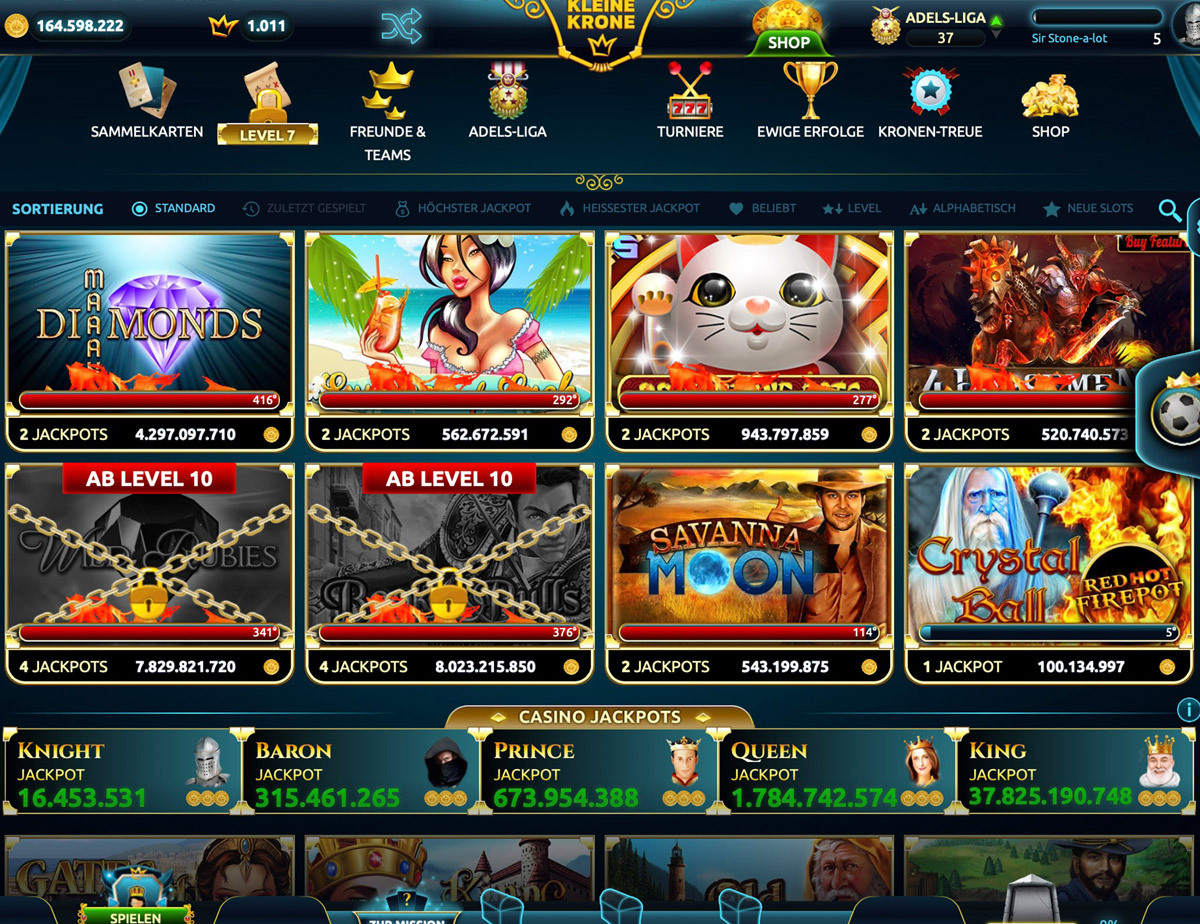
Our experience in the field of browser games came in handy here. We dug into our well-stocked bag of tricks and developed a league system in addition to simple quest series. In the case of the Kleine Krone we called it the Nobility League, as befits its status. Players start out at the jester level and the better and more you play, the quicker you advance to the knight, elector, or king league. Rewards such as gold, crowns, and trading cards are on offer, and features such as elixirs to level up winnings keep players on the ball. Even integrated timers and premium currencies to skip waiting times, as seen in many free-to-play games, are tailor-made for social casino platforms and fit right into the Kleine Krone. Anyone who has invested some time in a browser game will recognize the machinery behind it.
Play like a pro
In principle, online casinos all work according to the same principle: the virtual slot machines are integrated into a platform via an iFrame and can henceforth be accessed by players. The platform serves as an interface between the game and the provider. Users come with their virtual wallets and play one slot machine after the other. With each active slot machine, a session ID is opened. Every spin, every win, every button press generates a request for this session ID. With several thousand active users, the constant flow of data begins to accumulate.
However, it's not just the number of users that is important, but also their way of playing. There are hardcore users who click and click incessantly. It quickly became clear that the popular turbo mode had to be added to the casino. But how? Loading times, however short, are the death of any online casino. A server must process every action in less than 300 milliseconds, no matter how many users are currently active. If this is not achieved, user numbers will drop rapidly. With each spin, not only must gold be withdrawn, but the meta-games must also be served: Players gain experience, achievements must be taken into account and statistics must be updated.
Event-based solution based on a serverless architecture
After many internal tests and evaluations, we came up with the idea of using an event-based system. When a spin is detected, the players receive feedback within 100 milliseconds in the form of deducted gold. Only at this speed can a satisfactory turbo mode be possible at all. Everything that follows lands in a queue and is done gradually and discreetly in the background. The asynchronous processing of events takes an average of 70 milliseconds, with users not noticing the hidden waiting times at all.
However, this solution alone could not prepare the system for the onslaught of activity. The server infrastructure also had to be designed in such a way that it could process a high number of simultaneous requests as quickly as possible. Most platforms still rely on classic server structures, which are associated with high setup, maintenance, and administration costs. This is aggravated by the costly and constant upgrading of the servers as requirements increase. An obvious albeit equally cost-intensive alternative is an infinitely scalable serverless architecture such as Amazon Web Services (AWS). We didn't have to worry about server management with AWS, because it's automatic. Our task was simply to create an entry point. With AWS, every function of the Kleine Krone online casino runs without the need for servers to be provisioned or administrators to manage them.
Up to that point, it all sounds perfect. The only catch is the cost. All that computing time consumed via AWS Lambda must be paid for. As the number of users increases - and this will be the case with successfully running casinos over the years - more computing time is then consumed. This in turn leads to the architecture becoming even more expensive than without a server. This is fortunately counterbalanced by the fact that the serverless variant will be able to handle any number of users, including spontaneous peaks, when thousands more users are on the portal than usual. Even deployments can be carried out without downtime.
Years of know-how combined with innovative solutions
Within a year, our 6.5-person team succeeded in developing the product largely for the web on the basis of PHP 8, Laravel 8, Vapor, and Nova as well as Unity3D for cross-platform implementation with iOS and Android. We invested another year into the live optimization of the Kleine Krone, again by using well-known browser game mechanics. In the meantime, 400 games from various providers can be found on the online casino, but that is by no means the end of the story. As time goes on, more and more slot machines land on the portal - sometimes familiar slot machines in a new design or with a familiar IP. At peak times, the platform manages about 12 million web requests over 7 days with almost 148 events in the queue. With the serverless architecture, many more millions of requests are possible without a drop in performance.
